
NO HYPE AI · THE DISPATCH
Work every deal with your AI, and let it keep the ledger
About 8 deal notes a month to 81. Hand your AI your sheet or a screenshot, let it press you, and learn from your own decisions
Work every deal with your AI, and let it keep the ledger
About 8 deal notes a month to 81. Hand your AI your sheet or a screenshot, let it press you, and learn from your own decisions

Paul Cobb
October 12, 2026
Early this year I was logging about 8 deal notes a month. In September I logged 81.
What changed is I quit keeping deals in my head. When I look at a deal now, I work it through with my AI and it goes on the record: the numbers, what I thought of the house, what the seller's dealing with, how I'd buy it, and what I decided.
For years I wrote down almost nothing, so there was nothing to check my numbers against.
You're already evaluating deals. Do it with whatever AI chat you use, and let it keep the record.
Work the deal with your AI
Hand it whatever you already use for numbers. If you run deals in a spreadsheet, upload it or paste it in. If they live on a listing or a comp printout, take a screenshot.
Then talk through it like you would with a partner: what the numbers say, what you thought when you walked in, why the seller's selling, and how you'd buy it.
Talking it in from the truck works too. That's how most of mine go in.
Set it up once: a project called Deals, a new thread for each deal, and one thread called Ledger for the running list.
Do this on every deal, including the ones you pass on. The passes are half the lesson.
Tell it what to pull, every time
A ledger is only worth something if every row has the same fields. Tell your AI once what to pull, and it'll pull the same things on every deal as consistently as it can.
Paste this into your project instructions, or at the top of your Ledger thread:
Keep a running deal ledger for me. Every time I give you a deal, whether it's a spreadsheet, a screenshot, or me talking, pull what you can into one row, with the same fields every time. The numbers: asking price, my value estimate, my repair estimate, my offer, and any other key figures from my sheet. My read on the house: condition and my gut impression. The seller: their motivation and their situation. My approach: how I'd buy it and which exit I'm leaning toward. My decision and why: offer, pass, or follow up. The next step, with a date. Also keep the deal nickname (never the street address), town or neighborhood, lead source, and status. Never guess a number. If something's missing, leave it blank and ask me for it.
That last line makes it press you. Cut it if you'd rather fill in blanks on your own time.
Then, on each deal:
Here's my spreadsheet (or screenshot) for this deal. Pull it into a ledger row, then ask me about anything missing: my read on the house, the seller's motivation, my approach, and my decision.
When the row's done, paste it into your Ledger thread.
What it looks like on a real deal
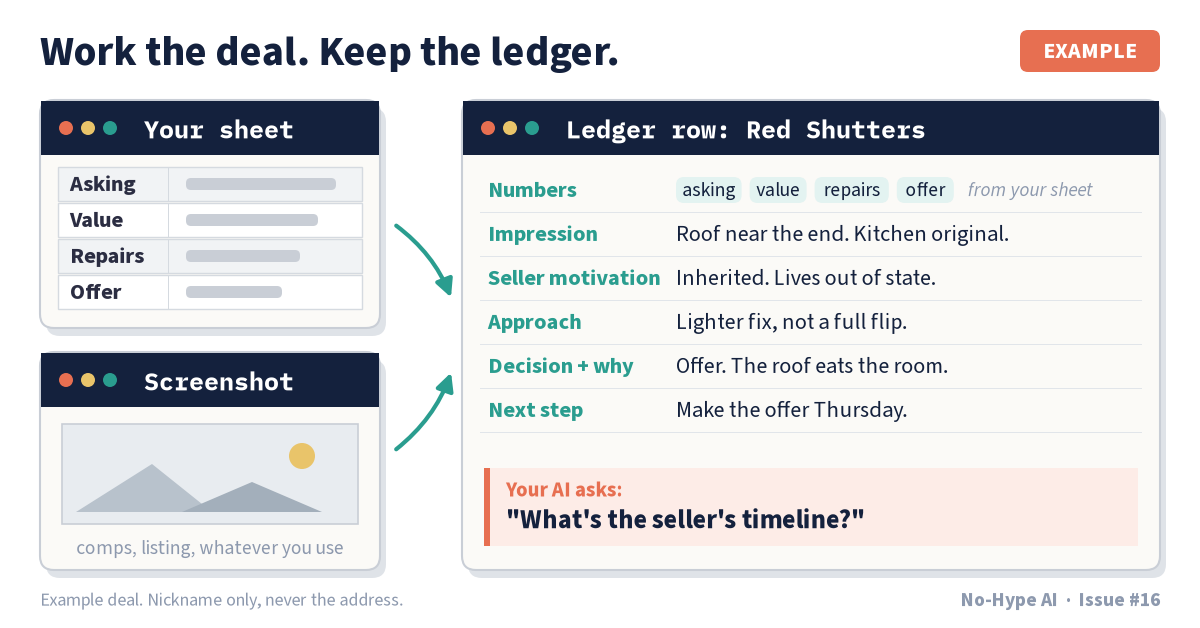
Here's a made-up one. Say you're looking at a brick ranch you're calling Red Shutters. You screenshot the numbers tab of your spreadsheet and the comps you pulled, paste them in with the deal prompt, and add one line: "Inherited house. Owner lives out of state. Roof's near the end and the kitchen's original."
The row comes back with the numbers pulled straight from your sheet: asking price, your value estimate, and your repair estimate. Condition picks up the roof and the kitchen.
Then it presses you:
"What's the seller's timeline?"
"Are you leaning toward a full flip or a lighter fix?"
"What's your decision: offer, pass, or follow up?"
You answer each in a sentence. She wants it handled before the holidays. You're leaning toward a lighter fix because the roof eats most of your room. You'll make an offer Thursday.
Now the row has the part that never makes it into a spreadsheet: why she's selling, how you'd buy it, and what you decided.
Once a month, ask it what you've been doing
Open the Ledger thread and paste this:
Here's my deal ledger for the month. Look at my numbers, my reads, and my decisions. Where do my repair estimates drift between the first look and my final number? Which seller motivations turned into offers or contracts, and which went nowhere? Which approach and exit do I keep choosing? What am I passing on, and do my reasons hold up? Where was my gut read on a house right, and where was it wrong? Keep it plain, and show me the rows behind anything you point out.
Say it tells you your repair guesses run light on the older houses. Or that the owners who needed out fast turned into deals, and the ones just testing the market never did. Now you know where to pad your number and where to spend your afternoons.
I think that's where the value is. Your numbers, your reads on sellers, and your decisions, read back to you plain, show you habits you'd never see one deal at a time.
When it goes wrong, and the fix
It fills in a number you never gave it:
Go back through the ledger. Mark every number that didn't come from my sheet or from me, and blank it out.
It grabs the wrong figure off a messy sheet, like your asking price landing in the value column. Ask where it got each one:
For this row, tell me where each number came from on my sheet or screenshot.
The Ledger thread gets long and starts losing rows. Start fresh:
Print the full ledger, every row and every field, so I can start a fresh Ledger thread with it.
If you're further along
You've probably heard about skills: saved instructions your AI pulls in when the job comes up. Turn the ledger setup into one and you stop pasting prompts. You don't need it to start.
Start this week
Today, make the Deals project and the Ledger thread, and paste in the setup prompt.
On the next deal you look at, hand it your sheet or a screenshot with the deal prompt and answer what it asks. Do every deal this month that way, passes included.
At the end of the week, say "show me the ledger" and fill in the blanks you can.
On the first of next month, run the analysis prompt.
Know an operator whose deal notes all live in their head? Forward this. And hit reply and tell me: what's the one field you'd add to your ledger?
Written by Paul Cobb, real estate operator (Louisville / Kentuckiana), forVEX builder. I run the plays I write about. More depth: forvex.app/journal