
NO HYPE AI · THE DISPATCH
What I Actually Use to Build My Apps (and What It Costs)
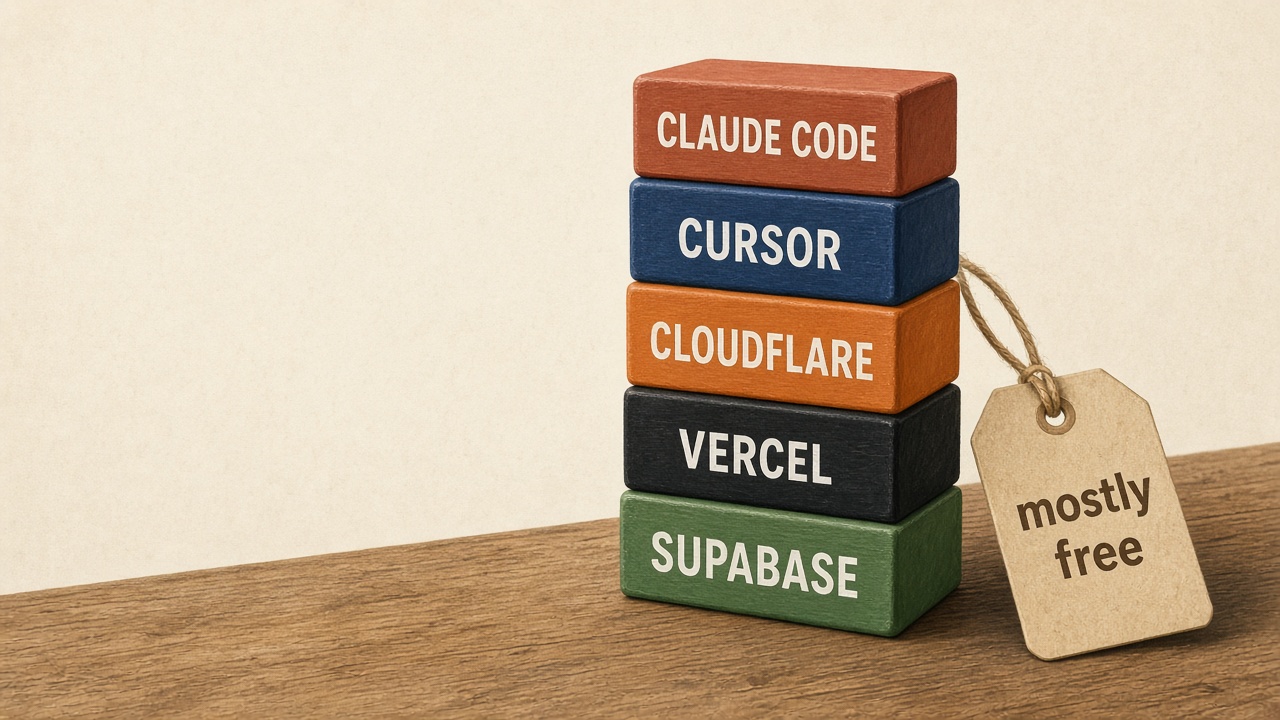
The whole stack I use to build my own apps, and what each piece costs. Most of it is free.
What I Actually Use to Build My Apps (and What It Costs)
The whole stack I use to build my own apps, and what each piece costs. Most of it is free.

Paul Cobb
October 16, 2026
A guy at a meetup asked me what it cost to run all my apps. He figured it was thousands a month. Maybe a developer on payroll.
It's not. Most of it runs on free tiers. The paid parts cost less than my cell phone bill.
Here's the whole stack.
The database is the business
Everything I build sits on one database. I use Supabase. It's Postgres underneath, which is boring in the best way. My deals, comps, rehab estimates, rentals, tasks, and scanned paperwork all live there.
Every app reads and writes the same tables. Edge for the pipeline and rentals. Deal for underwriting at the house. Build for rehab estimates. Scan for paperwork. Train for practicing seller calls. My AI tools hit that same database through a tool server I built called REcontrol. So a deal I run in a chat shows up in the pipeline without me copying a thing.
If you only spend money on one piece, spend it here. A paid database doesn't go to sleep when you take a week off.
Hosting and domains
My web apps run on Vercel. You push code, and it's live in a minute or two. For a solo operator the free tier goes a long way. Note that the free tier is for personal use, so a business app belongs on Pro.
Cloudflare handles my domains and DNS. The DNS is free. Domains are sold at cost, about eleven dollars a year for a .com.
Where the code lives
Every app has its own repo on GitHub. Free. That's my history, my backup, and the record of what changed and when.
Who writes the code
This is the part people don't believe. I'm not a career developer. I write code with Cursor and Claude Code.
Cursor is an editor with AI built in. I describe what I want, it drafts the change, and I review it. Claude Code works the same way from the terminal and is good at bigger jobs across a whole repo. Same rule as everywhere else in my business. It drafts. I approve.
The bill
Tool | What it does for me | Free tier | Paid (monthly) |
|---|---|---|---|
Supabase | The database every app and AI tool shares | $0 (2 projects, pauses after a week idle). Pay for overages | Pro from $25 |
Vercel | Hosts my web apps | $0 Hobby (personal use only) | Pro $20 |
Cloudflare | Domains and DNS | DNS free | About $11 a year per .com domain |
GitHub | Code, history, backups | $0 | Team $4 per user if needed |
Cursor | AI coding editor | Limited free | New plans: Plus $8 (Grok models only), Premium $30 (other models billed on top) |
Claude (Claude Code) | AI coding in the terminal, plus chat | Free chat, no Claude Code | Pro $20, Max $100 to $200 |
ChatGPT | A second analyst | Free | Plus about $20 |
Prices from each company's public pricing page, checked October 15, 2026. They change, so check before you sign up.
On the free tiers you can start for close to nothing. A serious paid setup lands somewhere around $150 to $200 a month. Mine runs about $180.
What makes it mature
It's not the price tag. It's that the pieces don't fight each other. One database. Code in one place with a history. Hosting that deploys itself. AI that writes code but doesn't ship it without me.
Five years ago this took a team. Now it takes a decent laptop, a few subscriptions, and the patience to learn.
So what's stopping you from building the one tool your business keeps asking for?
I write about this kind of thing every Monday in No-Hype AI. Plain talk on using AI to run a real business. Subscribe here if that sounds useful