
NO HYPE AI · THE DISPATCH
Start at the Bottom: Getting More From AI in Your Investing Business
For investors who use AI to write emails and draft documents, and want to get more out of it.
Start at the Bottom: Getting More From AI in Your Investing Business
For investors who use AI to write emails and draft documents, and want to get more out of it.

Paul Cobb
October 16, 2026
Does any of this sound familiar?
A seller called back three weeks later and had already sold to someone else. You forgot to follow up.
You can't say which of your last ten flips actually made money, or how much.
The contract is in your email, the photos are on your phone, and the bids are in a text thread.
Your AI chat gave you an ARV and you had no way to check where it came from.
Your VA or contractor has to ask you where everything is.
None of those are AI problems. They're systems problems. And they're the reason AI feels like a novelty instead of a business tool for most investors.
Most people start with the AI: which chatbot, which app. Start at the bottom instead. AI can only be as good as the information you can hand it.
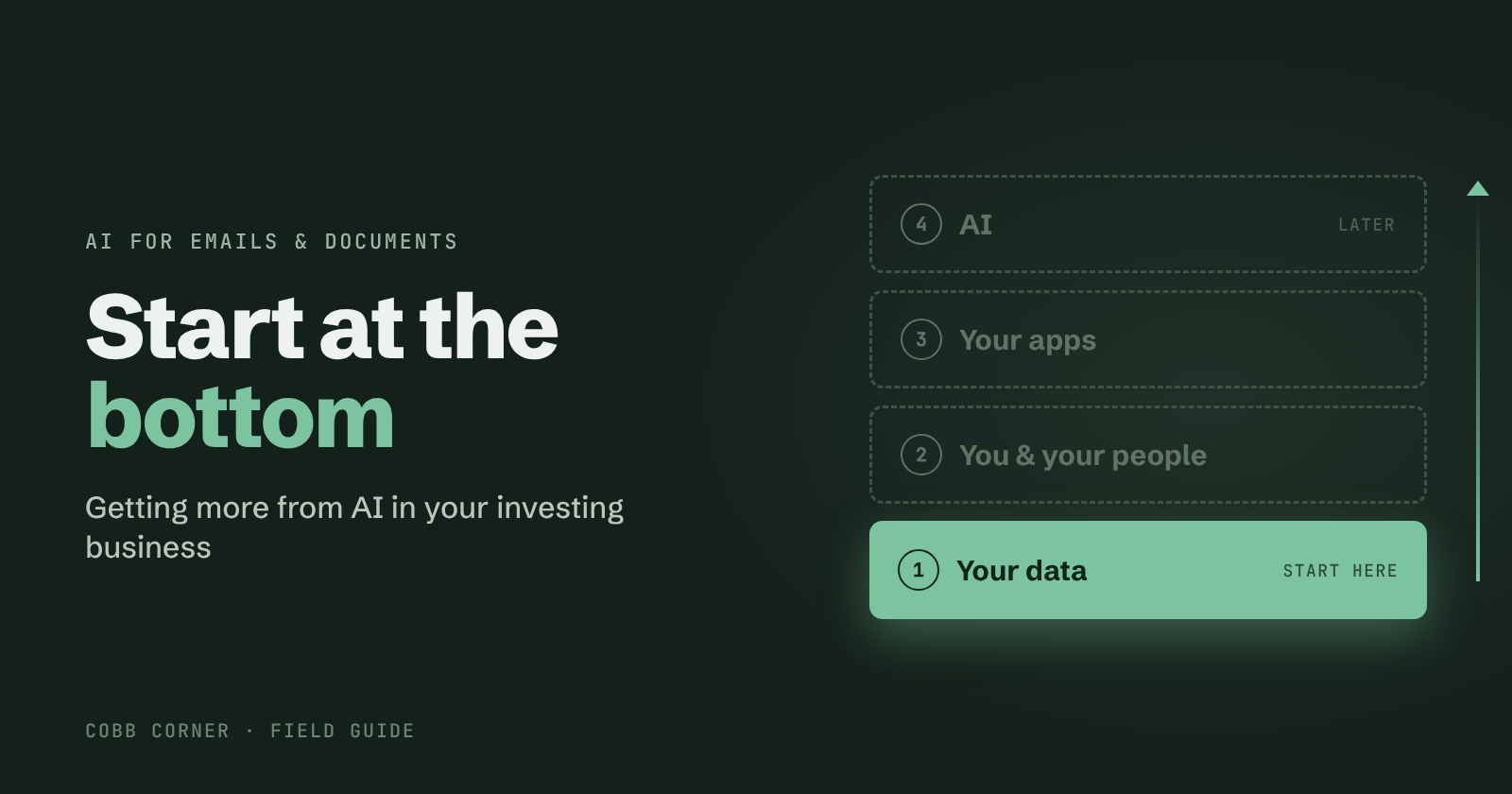
The four layers of your business
Every investing business, from a one-person operation to a full team, has four layers:
You and your people. The ones who make decisions and do the work.
AI. Chat assistants today, and later, AI that works on its own.
Your apps. The CRM, deal calculator, accounting and property management software you already pay for.
Your collection of data. Where your deals, numbers and paperwork actually live.
The mistake is building from the top down. The fix is building from the bottom up. Each step below makes the next one work. Skip one, and the layer above it wobbles.
Step 1: Give every record one home
Your collection of data. Most people start here.
Before any AI, get your information out of your head, your texts and your camera roll and into one place you control.
One list of every lead and deal. A spreadsheet or CRM with the address, seller, stage, next step and date.
One folder per property holding everything about it.
Two numbers on every deal: what you projected, and what actually happened.
A simple folder setup looks like this:
Deals/
  Deal 1 Ranch/
    contract.pdf
    comps.pdf
    rehab-budget.xlsx
    photos/
    closing-statement.pdf
  Deal 2 Duplex/
    ...
Good enough: one shared folder and one spreadsheet. You can upgrade later. What matters is that there's one place to look.
Step 2: Put one name on every job
You and your people.
A collection of data only stays useful if someone keeps it current. Decide who owns each piece, even if the answer is you for all of them.
Who updates the lead list after every call?
Who files the paperwork when a deal closes?
Who keeps the rehab budget current with real invoices?
Good enough: a short list taped to your monitor. If it's everybody's job, it's nobody's job.
Step 3: Know what your apps hold, and whether you can get it out
Your apps.
List every app you pay for. For each one, ask a single question: can I get my data out of this, or does it get stuck here?
An app that exports to a spreadsheet, or connects to AI directly, is worth more to you than one that doesn't. When you're choosing between two tools, this question should weigh as much as price.
Good enough: a list of your apps with "exports: yes or no" next to each.
Step 4: Now bring in a chat assistant
AI.
With your records in order, your AI chat becomes far more useful, because you can hand it real information instead of asking it to guess. Use it to advise you and to show you things. You still do the acting.
A few prompts to try with your own information:
Underwriting: "Here are 6 sold comps and my repair list for Deal 1 Ranch. Walk me through ARV and max offer and tell me where the deal is thin."
Looking back: "Here are my closing statements and original budgets for my last 8 flips. Which ones beat projection, which missed, and why?"
Appointment prep: "Here are my notes from the first call with this seller. What should I ask tomorrow, and what are they really worried about?"
Follow-up: "Write a short, friendly follow-up text to a seller I met two weeks ago who said they need to talk to their sister first."
Make it repeatable: when a prompt works well, save it in a document. That's your first written playbook, and it's how you get the same quality every time instead of starting from scratch.
Four ground rules from day one
AI drafts, you send. Never let it send an offer, text or email you haven't read.
Check the math. If it gives you a number, ask which comps and which costs it used.
Paper beats talk. A signed contract outranks what anyone said, including the AI.
Mind what you paste. Leave out bank details, Social Security numbers and anything you wouldn't email to a stranger.
Map your own stack
Take ten minutes and answer one question per step, starting at the bottom. Your first "no" is where to start.
Data: If you were gone a month, could someone find every open deal, its numbers and its paperwork?
People: Is there one name next to keeping the lead list, the paperwork and the budgets current?
Apps: Do you know which of your apps let you get your data out?
AI: Do you have even one saved prompt you reuse every week?
What comes next
Once these four steps are in place, the next move is AI that works on its own: a morning briefing waiting for you, a weekly check on what competitors bought, follow-up drafts ready for your approval. That only works well on top of a solid foundation.
When you're there, read the companion piece: The Four-Layer Stack: A Framework for Building With AI in Your Investing Business