
NO HYPE AI · THE DISPATCH
The Four-Layer Stack: A Framework for Building With AI in Your Investing Business
For investors who are building tools and processes with AI: connecting apps, writing playbooks, or setting up agents.
The Four-Layer Stack: A Framework for Building With AI in Your Investing Business
For investors who are building tools and processes with AI: connecting apps, writing playbooks, or setting up agents.

Paul Cobb
October 16, 2026
Once you move past using AI to draft emails, the questions change. Which tool talks to which? Where should the data live? What should an AI be allowed to do on its own? Without a map, it's easy to end up with a pile of clever automations that don't fit together.
Here's the map I use. It's tool-agnostic. The names below are examples, so swap in whatever you use.
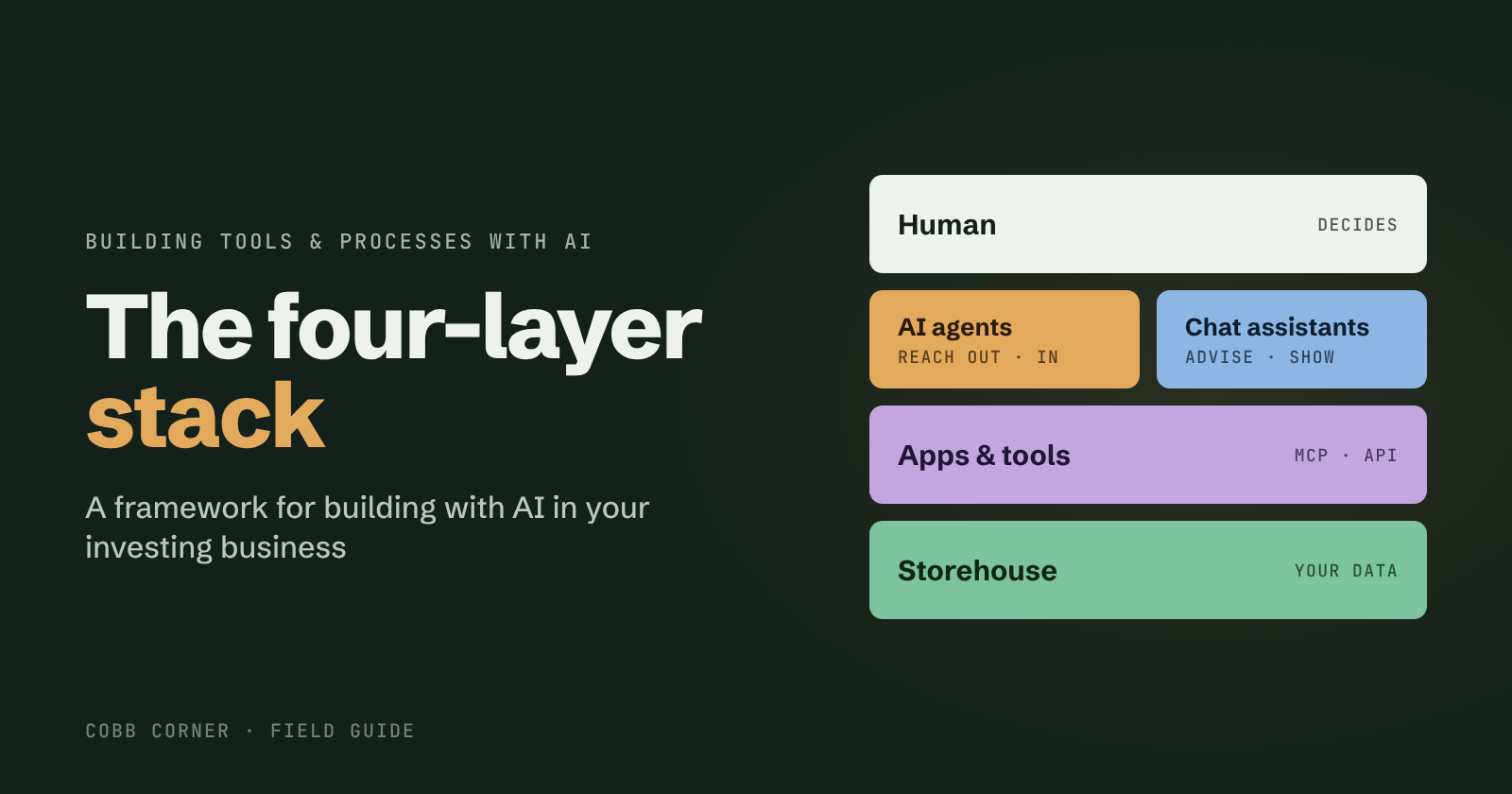
Built from the bottom, read from the top. The build order is always your data first, then people and owners, then apps, then AI. Agents sit on top because they depend on everything below them.
Layer 1: Human
You are the owner, the operator and the final say. You set direction, make the calls, and approve anything that leaves the building: offers, money, emails, posts. Everything below exists to give you better information and more hours back.
Layer 2: AI, in two different jobs
Most people treat "AI" as one thing. It's really two, and the difference matters.
AI agents: reach out and reach in
Examples: a bot that runs on a schedule, or an agent you set up in your AI chat.
Agents reach out to the world for information: county records, listing sites, competitor ads, email. They reach in to your apps and data to read, file and update. Each one has a standing job and can run on a schedule, not only when you ask. Agents run on skills (written playbooks) and tools (approved actions inside your apps).
Chat assistants: advise and show
Examples: your AI chat, whichever one you use.
Assistants advise on a deal, a seller or a budget. They show you the math, a chart or a draft. They work when you ask and hand the answer back to you. You do the acting. Assistants run on prompts and skills.
Layer 3: Traditional apps and tools
Your CRM, deal analyzer, comps tool, rehab estimator, accounting, property management, email and calendar. The software you already pay for, each tied to its own records.
The key question for every app is how AI can get in. From best to worst:
MCP connector: AI can use the app directly with approved actions.
API: AI can get in, but someone has to build the connection.
Scheduled export: the data comes out on a schedule into your storehouse.
Copy and paste: you are the connector.
Layer 4: The storehouse
Your collection of data: a database, shared folders, spreadsheets, document storage. Deals, properties, comps, budgets, contracts, closing statements, notes. It can be one database or a well-organized set of folders. What matters is that each kind of record has one home, and that people, apps and AI all read from that same home.
What connects the layers
Prompt: what you type in the moment. "Is my offer on Deal 1 Ranch a good one given these comps?"
Skill: a written playbook the AI follows the same way every time. "How we underwrite a flip."
Tool: an approved action into one of your apps, through MCP or an API. Look up comps, save a deal, create a task.
Four examples of a request moving through the stack
"Should I make this offer on Deal 1 Ranch?"
Chat assistant: advise and show.
You ask. The assistant loads your underwriting skill so it uses your buy box and your formula. It pulls comps and rent from your comps tool through a connector, then shows you ARV, repairs, max offer and where the deal is thin. You decide. Nothing was saved or sent without you.
"Every Monday, check what competitors bought and sold."
Agent: reach out, then reach in.
The agent runs on schedule with a skill naming which buyers, which zip codes and what counts as a finding. It reaches out to deed records and listing sites, reaches in to file each finding against the property, and sends you a summary. After a quarter, you know who buys in your areas and what they pay.
"Brief me every morning at 7."
Agent: reach in only.
The agent reads your CRM and calendar for today's appointments, stale leads and deals near a deadline. It checks your notes on each seller you're meeting and drafts follow-up texts for stale leads, held for your approval. You get one page and approve, edit or toss each draft. It reaches in, never out on its own.
"Is the Deal 2 Duplex rehab on budget?"
Agent and assistant together.
An agent files invoices from email into the job folder every week. Your rehab estimator compares them to the budget line by line. When you ask, an assistant shows actual vs. budget by category and what's left. Agents keep the records current; assistants explain them.
Key piece 1: Keep a history, not just the current state
Most investors track where a deal stands today. AI gets far more useful when your storehouse also keeps what happened, who did it, and what you learned.
Facts: every property and every analysis you ran, projected vs. actual on every closed deal, signed paperwork.
Events: every status change from lead to sold, and a log of what each person or agent did.
Lessons: a seller's real bottom line and who told you, and where your estimates missed.
Market: competitor buys, sells and price changes; neighborhood trends; watchlists.
Not all information is equal. Teach your AI to rank it:
Paper: contracts, deeds, closing statements, invoices. The final word.
System: your analyses, status history and comps.
Someone said it: a call, a note, an AI's conclusion. Useful, but it never overrides the paper.
Two habits make history usable. First, tie every note, document and agent finding to a specific deal or property record, not a typed-in address, or "the ranch" and "Deal 1 Ranch" become two houses. Second, log agent work as a proposal first: proposed, then approved, then done, or dismissed.
Key piece 2: Know your owners, players and roles
Owners: every record and every job has one person accountable for it. An agent can do the work, but a person owns the outcome.
Players: who and what touches your business, and what each is allowed to do.
You: read everything, change everything, send anything.
Team, VA, property manager: work their assigned lanes, within limits you set.
AI agents: read their lane's records, write logs and proposals, send nothing outside without your yes.
Chat assistants: see what you share or connect, change nothing by default, send nothing.
Apps: manage their own data and send what you configure them to send.
Roles: the jobs that need doing, whoever ends up doing them.
Owner / Operator: direction, decisions, approvals. Played by you.
Chief of Staff: morning brief, triage, routing work. An agent or assistant.
Acquisitions: lead screening, appointment prep, underwriting. You plus an assistant.
Marketing: content plan, post drafts, competitor watch. An agent, with your approval.
Finance: cash, KPIs, payables, projected vs. actual. A bookkeeper plus an agent.
Operations: rehab budgets and schedules, rentals. A property manager plus an agent.
Process keeper: writes and updates the skills, and onboards new people and new AI. You plus an assistant.
Key piece 3: The worker is not the approver
Treat every AI like a capable new hire with access to your sellers, your money and your name. Give each one only the access its job needs, make sure you can pause it, and keep anything that goes outside behind a human yes. Put those rules in settings and permissions, not only in instructions. An AI can ignore an instruction, but not a permission it doesn't have.
The safest setup is not the one with the AI you trust most. It's the one that lets you trust the AI the least.
Map your own stack
Answer one question per layer, from the bottom up. The weakest layer limits everything above it.
Storehouse: Does each kind of record have exactly one home, with history and projected vs. actual?
Apps: Which apps have an MCP connector or API, and which still trap your data?
AI: Which of your weekly jobs have a written skill? Which agents can send anything without your yes?
You: Is there one owner on every record and every agent's job, including the ones a bot runs?
If the first question gave you pause, start with the companion piece: Start at the Bottom: Getting More From AI in Your Investing Business