
NO HYPE AI · THE DISPATCH
Numbers never come from the model's memory
Two AI chats, one deal, same numbers. Here's the setup that makes that happen, and the prompts to copy.
Numbers never come from the model's memory
Two AI chats, one deal, same numbers. Here's the setup that makes that happen, and the prompts to copy.

Paul Cobb
November 09, 2026
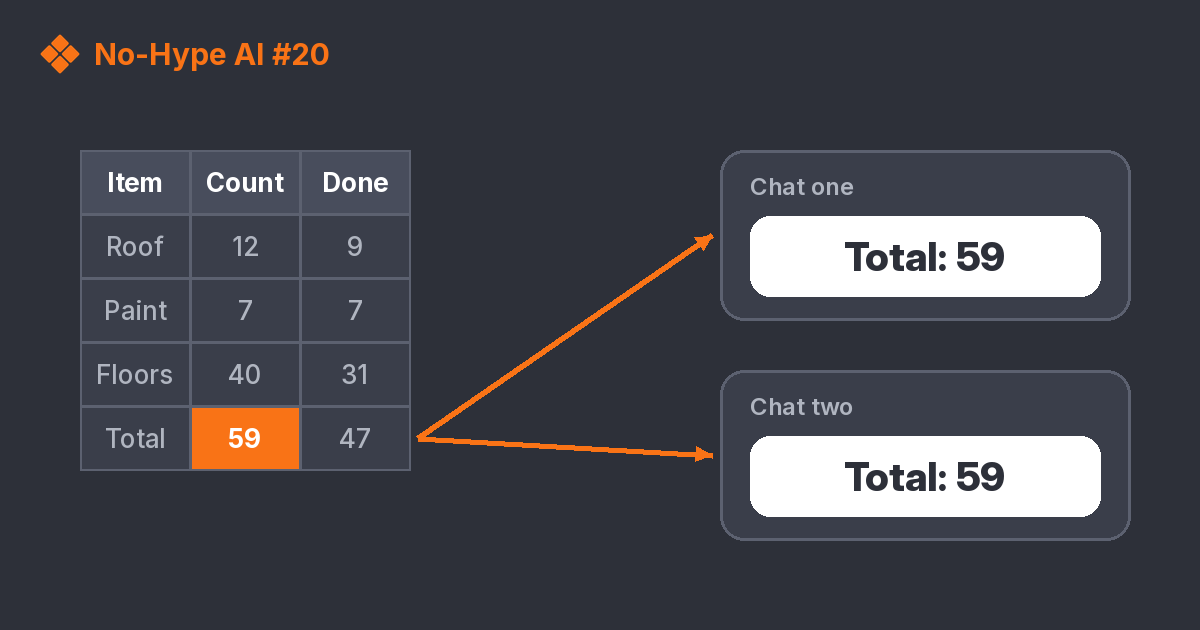
A few weeks back I ran the same deal through two different AI chats. Same house, same question. They talked to me differently. The data was the same, and so were the conclusions.
That's not luck. It's the rule I built everything around. Numbers come from my records and my engines. They never come from the model's memory.
Why the model's memory is the wrong place
Ask a chatbot what a three-bed in your part of town sells for and it'll answer. It'll sound sure. It's guessing from whatever it read a while ago. It doesn't know your buyers, your contractors, or what your last roof cost.
So I split the job in two. Your AI decides what to ask and how to explain the answer. The math happens somewhere you control.
On my side, when I ask about a deal, my AI doesn't make up comps. It pulls the sold comps I've recorded. It doesn't ballpark the rehab. It hands the room-by-room condition to my rehab estimator and gets back a line-item budget. Same for rent and flood. Then it does what it's good at. It reads the results, spots what looks off, and tells me in plain English.
That's why I can swap models without worrying. Neither one is doing the math.
You can build a version of this with a spreadsheet
You don't need a database. You need a truth sheet and a few hard rules.
The truth sheet. One spreadsheet with three tabs.
Comps: date sold, area, beds, baths, square feet, condition, sold price, and where you got it.
Costs: your real costs from past jobs, by line item. Paint per room, flooring per room, a roof, a furnace, a dumpster. Whatever you've actually paid.
Deals: one row per deal with the inputs you used and what you decided.
When the AI and the sheet disagree, the sheet wins.
The setup prompt. Put this at the top of a project, or paste it at the start of every deal chat:
You're my underwriting analyst. Use only the numbers I give you in this chat or in the attached sheet. Never use a number from your own memory. If you need a number I didn't give you, stop and ask me for it. For every number in your answer, put the source in brackets: [Comps row 4], [Costs: roof], or [Paul said]. If you can't point to a source, don't use the number.
The deal prompt.
Here's a new deal: [area, beds, baths, square feet, condition notes]. Pick the comps from my Comps tab that fit, and tell me why each one fits or doesn't. Build the repair list from my Costs tab only. Walk me through value, repairs, and the most I could offer. Then tell me which number you're least sure of, and why.
That last question is the one I'd never skip. It points you right at the soft spot.
Check its work before you use it
The source check. After any answer with numbers in it:
List every number you used and where it came from. Mark anything that came from you instead of me.
If anything gets marked, throw it out and give it the real number.
The two-chat test. Open a fresh chat, or a different AI chat, and give it the same sheet and the same prompt. If the numbers move, something was being guessed. If only the wording moves, you're fine.
The empty test. Ask the same deal question with no numbers at all. Compare the two answers. The gap between them is how much it was willing to guess.
Where this saved me
The first time it paid off was on a rehab number. A chatbot's ballpark came in way over what I'd actually spend, going by my own past jobs. If I'd trusted it, I'd have offered too little or passed on a good house.
It also sped up my first pass on a deal. Getting from the first comp pull to a saved analysis used to take me about 25 minutes.
What goes wrong
It slips in a number anyway. Long chats drift. Twenty messages in, it starts "remembering" a comp you never gave it. Fix: start a fresh chat for every deal, and run the source check before you trust a total.
Your sheet is stale. The AI did its job. Your Costs tab still has last year's prices. Fix: every time a real invoice comes in, update the line on the sheet. Five minutes, every time.
It picks comps you wouldn't. It grabs a sale across a busy road, or a house in much better shape. Fix: add your comp rules to the setup prompt. "Same side of [road]. Sold in the last six months. Condition within one step of mine. Tell me what you dropped and why."
It rounds in your favor. A deal that's thin starts reading fine. Fix: ask for the low case every time. "Now run it with the lowest fair value and the highest fair repair number."
Why this matters for a small shop
Big companies have analysts down the hall to check the numbers. Most of us don't. When a chatbot hands you a clean paragraph with a confident number in it at 10 at night, there's nobody to catch it.
Keeping the numbers out of the model fixes that. It doesn't matter how sure it sounds. If the number didn't come from your data, it doesn't go in the offer.
Do this this week
Build the truth sheet. Start with your last five comps and the last ten real costs you can find.
Paste the setup prompt into a new project called Deals.
Run your last real deal through the deal prompt, then the source check.
Run it again in a fresh chat. Did the numbers hold?
Every invoice that comes in this week goes on the Costs tab.
So where are you letting your AI guess a number you already know? Hit reply and tell me.
Paul