
NO HYPE AI · THE DISPATCH
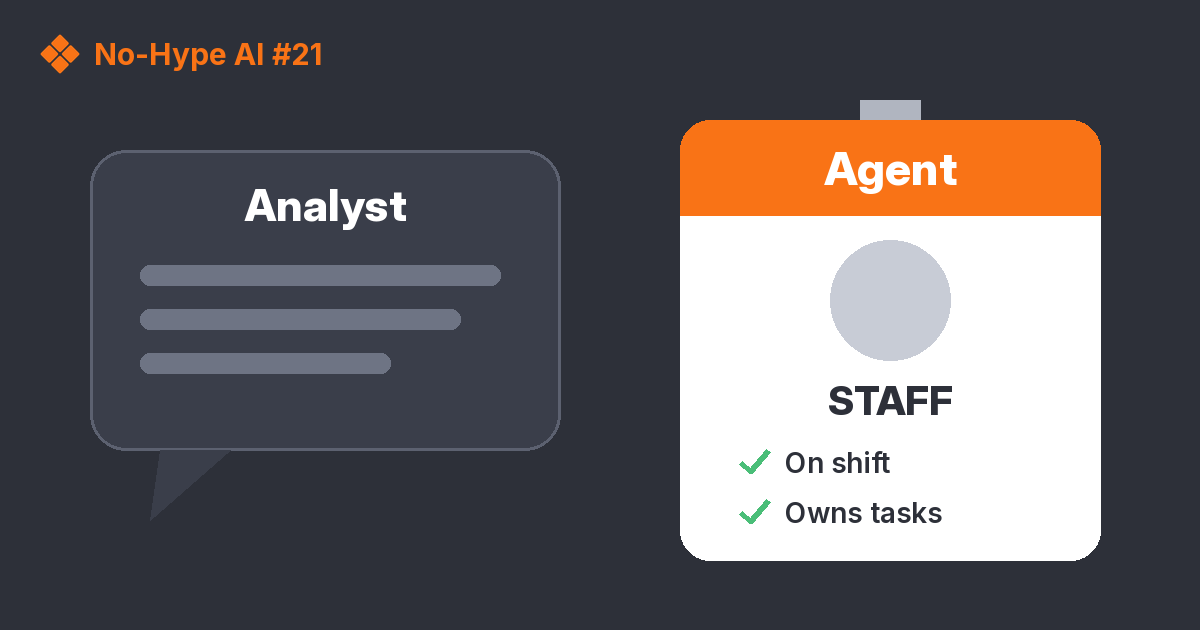
My chatbots are analysts. My agents are staff.
One answers when I ask. The other shows up with a job to do. Here's the job card I write for every seat.
My chatbots are analysts. My agents are staff.
One answers when I ask. The other shows up with a job to do. Here's the job card I write for every seat.

Paul Cobb
November 16, 2026
People ask me which AI I use. The honest answer is two kinds, and they do different work.
My chat AI is my analyst. My agents are my staff. Once I saw it that way, the whole thing got easier to run.
Analysts answer when you ask
An analyst sits there until you bring it a question. I ask about a deal. It pulls my data, runs my math, and explains what it found. When I close the chat, it's done.
That's most people's AI today. It's useful, and it's limited, because nothing happens unless you remember to ask.
Staff have a standing job
A staff seat has a job that runs whether I think about it or not. It shows up on a schedule, does the work, and leaves it on my desk.
Three of mine:
One checks the marketing calendar every weekday morning and only speaks up if something's broken or empty.
One watches the rentals across 26 doors and flags only what needs me.
One watches leads I'm tracking and marks them lost when the county shows the house sold to somebody else.
The test for which one you need
Ask one question about the job: does it need to happen whether or not I remember?
If no, it's analyst work. Deal questions, a tricky email, a repair bid. Bring it when you have it.
If yes, it's a staff job. Checking for problems, following up, watching the market, keeping a calendar full. Those are the jobs that slip when you get busy.
The sign for me was asking the same question every Monday. A question you ask on a schedule is a job. Write it down.
The job card
Every staff seat in my shop has the same things written down. Copy this:
Seat: [name the role, like Rentals Watch]
Job in one sentence: [what it does]
Runs: [when, like every weekday at 7]
Reads: [exactly what it looks at]
Can touch: [what it's allowed to change, if anything]
Never: [what it can't do, like send anything outside the business]
Speak only if: [the conditions that earn you an alert]
Bring me: [the exact shape of the report]
Reports to: [you, or another seat]
Here's my weekday marketing check, filled in:
Seat: Marketing calendar check
Job: Make sure the next two weeks of posts are scheduled and follow the rules.
Runs: Every weekday morning.
Reads: The content calendar for the next two weeks.
Can touch: Nothing. Read only.
Never: Publish, schedule, or edit a post.
Speak only if: Something failed, something breaks a content rule, or a day is empty.
Bring me: One line per problem, with the date and what's wrong. If nothing's wrong, say nothing.
Reports to: Me.
Speak only if
That line took me the longest to get right. Early on, my calendar check flagged the same things every day, and I started tuning it out. A staff seat that cries wolf is worse than no staff seat at all, because it trains you to ignore it.
So every job card now has a "speak only if" line, and "say nothing" is a real answer. The day my calendar check goes quiet is a good day.
Two more rules that cut the noise:
Don't repeat yourself. If I've already seen an alert and nothing changed, don't send it again.
One line per problem. If it takes a paragraph to explain, it goes to an analyst.
Run a standing job before you have agents
You don't need agent software to try this. You need a calendar reminder and a saved prompt.
Write the job card.
Set a reminder for when it runs.
When the reminder goes off, open your AI chat, paste the job card, then paste whatever it reads. That's your calendar, your rent roll, or your lead list.
Add one line: "Follow the job card. Speak only if a condition is met."
Do what it tells you, or dismiss it, and write down which.
Run that for three weeks. If it's earning its keep, that's the job to hand to a real agent first. If it's not, you saved yourself the build.
Analysts make staff better
The two kinds work together. When a flag comes in, I take it to a chat with the paperwork behind it and dig in. The staff seat caught it. The analyst helps me think it through. I make the call.
The org chart
I set it up like a small company, because that's how I think.
Chief of Staff: takes my asks and routes them to the right seat.
Marketing: a lead with writers under it for the blog, social, and strategy.
Money: watches the numbers.
Operations: a flip manager and a property manager.
HR: keeps the playbook and onboards new assistants.
Every seat has a job card, a schedule, and limits. None of them can send anything out in my name without my sign-off.
What goes wrong
Hiring staff on day one. I didn't. I started with an analyst and noticed I kept asking the same Monday question. Start there.
Vague reads. "Check my email" isn't a job. "Read the inbox for new competitor deal blasts and log each one" is.
No never line. If you don't write down what it can't do, you'll find out the hard way what it can.
Two seats, one job. If two seats both watch your leads, you'll get two answers. One job, one seat.
Do this this week
List every question you asked your AI more than once in the last month.
Circle the one you ask on a schedule.
Write its job card. Make the "speak only if" line strict.
Set the reminder and run it by hand three times this week.
So what question do you find yourself asking every single week? That's your first hire. Hit reply and tell me what it is.
Paul