
NO HYPE AI · THE DISPATCH
12 AI habits, adapted for a real estate operator
My buy box lives in a file. Yours should too.
12 AI habits, adapted for a real estate operator
My buy box lives in a file. Yours should too.

Paul Cobb
October 05, 2026
Most AI habit lists are written for people whose work ends in a document. Mine ends in a signed contract.
So when Sabrina Ramonov put out her twelve AI foundations (the write-up, the video), I went through them with my desk in mind. Her list is general and good. Disclosure: she also built Blotato, which I use for social. That's not why she's here.
Here's what I noticed going down it. The habits that hold up best on a real deal share one move: a rule, written down once, somewhere the AI reads it every time. Her numbers, my version.
1. One template for every seller follow-up.
Stop typing it fresh. Fill the same blanks every time:
Role: you're drafting a follow-up for a local home buyer. Situation: [who the seller is, by role; what they told me; where we left it]. Task: a text under 60 words. Tone: plain, warm, no pressure. Never include an offer number, a deadline, or a promise about timing. Give me two versions.
Offer numbers happen on a call. The template says so every time, so you never have to remember to.
2. Spar before you offer.
Issue #1 was sparring over your business. The deal version is narrower:
Here's the deal and the offer I'm planning [paste]. Argue that I'm wrong. Which number am I most likely to have wrong, and what does it cost me if I do?
You're not looking for agreement. You're looking for the assumption you hoped nobody would ask about. Save the prompt, and make it a rule that no offer goes out until it's been argued with.
3. A tutor that quizzes back.
When something's new, a title wrinkle or a financing structure you haven't used, don't ask for an explanation. Ask it to teach you in five minutes, then quiz you until you miss one. “I’m making an offer on a manufactured home, teach me about the key paperwork needed to make it sell faster”. Anything legal still goes to your attorney. It's a tutor, not counsel.
4 and 5. Skills and memory: my buy box lives in a file.
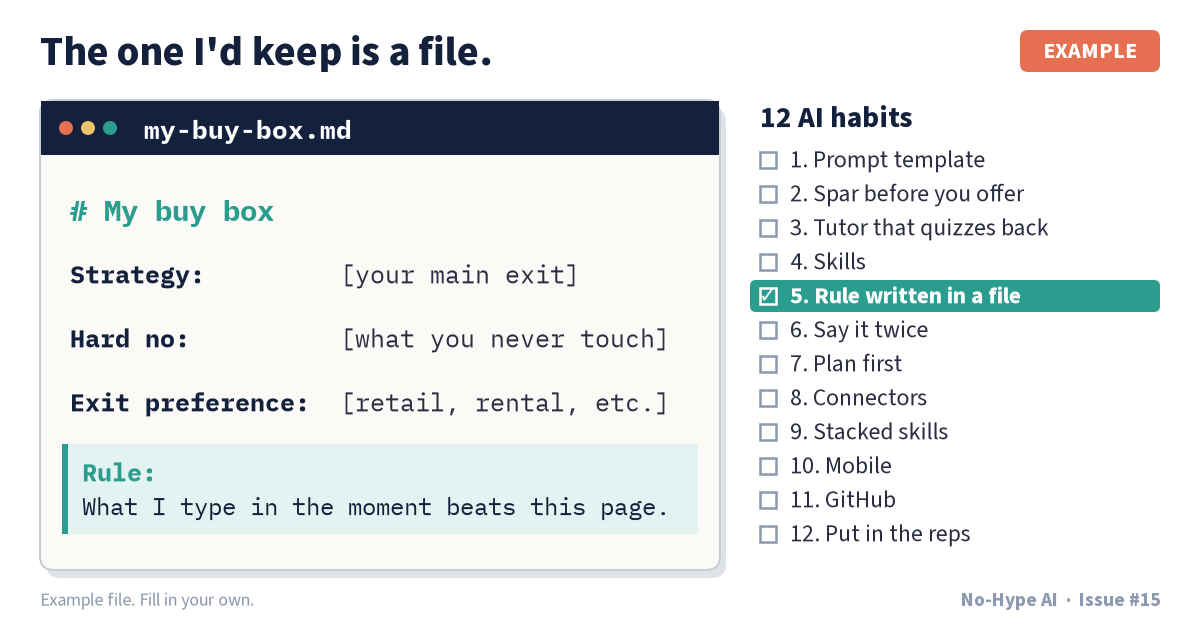
If I could keep one habit, it's this one. Before my underwriting skill touches a deal, it reads my buy box: (e.g. Light to Medium rehabs, nothing over $80K unless it’s a specific case). That lives on the forVEX server, with a plain my-buy-box.md file as the fallback when the connection's down.
The part people skip is the pecking order, written down: what I type in the moment beats the buy box, and the buy box beats the tool's defaults. Without that line, the bot runs on somebody else's rules. With it, the underwriting skill doesn't need to know my rules. It knows where to look. The skill is the how. The file is the who.
6. Say the important rule twice.
Long conversations drift, and the rule you stated at the top is the one it drops first. Put it at the top and again at the bottom. My own setup does this on purpose: "no addresses" is written into my project instructions, my writer file, my grader, and my issue template. Four places. Redundant is the point.
7. Plan before it builds.
Ask for the plan, argue with the plan, then let it build. My plan is the five-line spec from Issue #5: task, why, outcome, constraints, verification. And any tool that writes to my records has two rules baked in: read the change back to me before it saves, and re-read it after. It doesn't get to say "saved" until the re-read matches.
8 and 9. Connectors plus stacked skills make an employee.
A connector (MCP) lets the AI reach a system you already use. A skill tells it how you want the job done. Stack a few and you start delegating.
My marketing lane is the working example. It reads my social queue in Blotato and my newsletter in Beehiiv, writes a snapshot into forVEX Edge, the command center in my stack, and drafts posts against my own hook rules. It does not publish. Every draft waits for my thumbs-up, and that gate is the difference between an employee and a liability. This issue came out of that same stack: drafted, then graded against my own rubric before I read a word of it.
10 and 11. Mobile and GitHub are real habits. Get the other ten first.
12. Put in the reps.
I’ve been working with AI daily for over a year now, so it takes time to build up the infrastructure, the framework, the techniques. The operators getting leverage aren't smarter about AI. They open it every day on real work and fix one rule each time.
Where it breaks.
Written rules make drafts better. They don't make decisions. A template can still write a text you wouldn't send, and an employee can do the wrong job fast. Every one of these should end with you reading it before it goes anywhere.
The play. Write your buy box down this week. One page, plain English: what you buy, what you never touch, how you like to exit, and one line that says what you type in the moment beats this page. Put it where your AI reads it before every deal. Most of the other eleven get easier once that page exists.
Know an operator whose AI still doesn't know what they buy? Forward this. And hit reply with the one rule you'd put at the top of your buy box. I read every one.
Credit: the twelve habits are Sabrina Ramonov's (AI Foundations). I pointed them at real estate.
Written by Paul Cobb, real estate operator (Louisville / Kentuckiana), forVEX builder. I run the plays I write about. More depth: forvex.app/journal