
NO HYPE AI · THE DISPATCH
You don't need my systems to start
Six steps, a prompt for each one, and the sign that tells you it's time for the next.
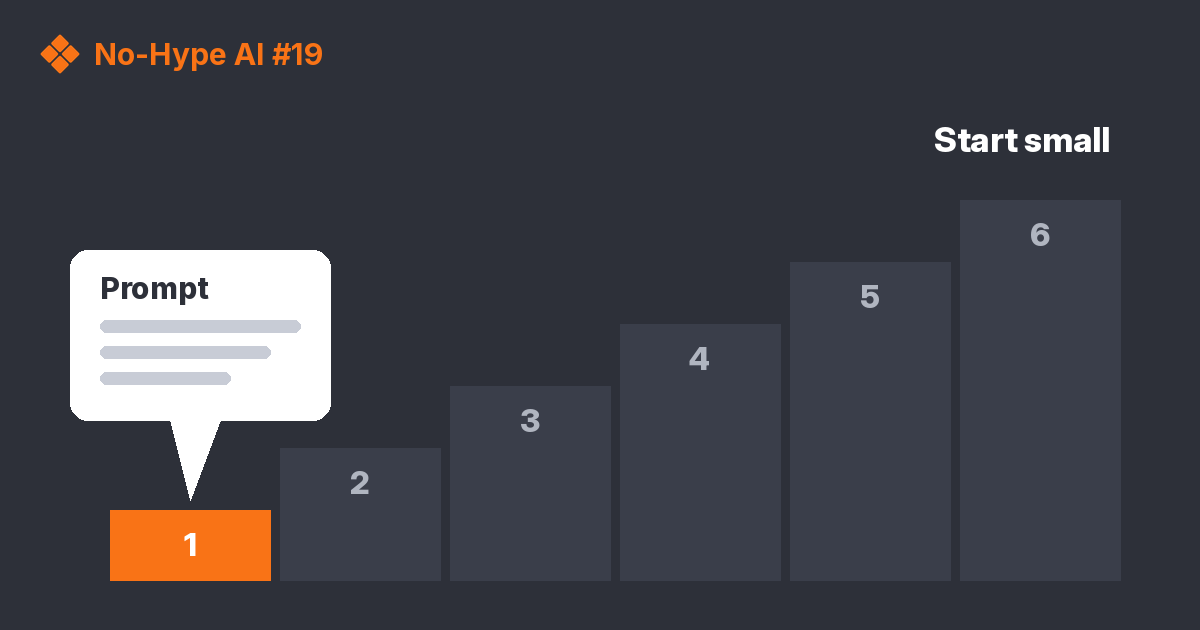
You don't need my systems to start
Six steps, a prompt for each one, and the sign that tells you it's time for the next.

Paul Cobb
November 02, 2026
Last month a business owner in a networking group I'm in asked me what software he needed to buy to "do the AI thing." I told him none yet. He looked at me like I was holding out on him.
I wasn't. I've got a database, a pile of apps, and a team of agents now. None of that is where I started. I started by pasting a deal into a chat window and asking a question.
Here are the six steps, in the order I'd do them again. Each one pays off on its own, and each one has a sign that tells you you're ready for the next.
Step 1: Ask about a real decision
Use your AI chat as a second set of eyes on something you're about to decide. Not a test question. A real one.
My first real use was pasting in a contractor bid and asking what looked high. It caught a line I'd skimmed past. I still made the call.
Here's a bid I got for [job]. Go line by line. Flag anything that looks high, anything that's missing, and anything that's vague enough to turn into a change order. Don't tell me whether to take it. Tell me what to ask the contractor.
That last line matters. You want questions back, not a verdict.
Move on when: you catch yourself pasting the same kind of thing in every week.
Step 2: Hand it the job you never get to
Every business has one. Mine was competitor research. I always meant to track what other buyers in town were listing and what they sold for. I never did it.
Now the deal blasts and listings that land in my inbox get logged in one place, the same way every time. After a few weeks I had a pretty good feel for what was moving and where
You can start this by hand in a chat:
Here are this week's [competitor emails / listings / ads], pasted below. Pull each one into a row: date, area, property type, asking price or terms, and anything that changed from last week. Keep the same fields every time. At the end, tell me what's new.
Move on when: the results are useful but they come out a little different every time.
Step 3: Write down how you do it
That inconsistency is the sign you need a written method. I call these skills. One page, plain orders. I've got one for underwriting, one for rehab estimates, and one for prepping before I meet a seller.
Job: [one sentence].
Use only: [where the facts come from].
Steps: [numbered, the way you'd tell a new hire].
Done looks like: [the exact shape of the answer].
Stop and ask me before: [the lines it can't cross].
Paste that at the top of a chat, or save it as project instructions. #22 goes deep on this.
Move on when: it does the job the same way three runs in a row.
Step 4: Keep the approval
Let it draft. You check it and send it.
Every post on my business pages gets drafted by AI, and every one waits for my yes. When an agent does work, it lands as a proposal. I confirm it, or I dismiss it. Anything that leaves the building gets my sign-off.
The rule I use: the thing that did the work doesn't get to approve the work. If your AI writes the email, you send the email.
Move on when: you've read a few weeks of its drafts and you're changing less each time. That's when it's earned your real numbers.
Step 5: Connect your numbers
Give it your own data so it answers from your history instead of its guesses.
This is where it got useful for real. My deal notes, my comps, and my rental records sit in one place my AI can read. When I ask about a deal, it answers from my history. It also watches the county deed records on leads I'm tracking. When a house sells to somebody else, it marks the lead lost. I don't find out three months later.
You can start with a spreadsheet:
Use only the numbers in the sheet I've attached. If you need a number I didn't give you, stop and ask me. For every number in your answer, tell me which row it came from.
Move on when: you're asking it the same question on a schedule.
Step 6: Add seats
A question you ask every Monday is a job. Give it a standing job and it becomes staff.
I've got 26 doors. My AI watches rent, leases, and repairs across all of them and flags only what needs me. That started as one job. Now there's a chief of staff seat, a marketing lead with writers under it, a seat on the money, an operations lead, and a seat that keeps the playbook. Each one has a written job, a schedule, and limits. #21 shows how to write one.
What goes wrong
Skipping steps. People jump to step 6 because the demo looked good. They end up with a pile of automations they don't trust. If you can't say what a seat does in one sentence, you skipped step 3.
Asking for verdicts. "Is this a good deal?" gets you a confident guess. "What would have to be true for this to work?" gets you something to check.
Letting it fill blanks. If you didn't give it a number and it used one anyway, that number came from nowhere. Make it ask.
I'm at step 6 in some seats and still at step 1 or 2 in others. That's normal. The order matters more than the tools.
Do this this week
Pick one decision on your desk right now. Run the step 1 prompt on it.
Write down the one job you never get to. Just the one sentence.
Next time that job comes up, run the step 2 prompt instead of skipping it.
Friday, look at what came back. Same fields every time? If not, you're ready for step 3.
Don't buy anything this week.
So what's the one job in your business you never get to? Hit reply and tell me. I read every one, and the good ones might end up in a future issue.
Paul