
NO HYPE AI · THE DISPATCH
Same checklist, every deal
About 25 minutes down to about 6, and the checklist prompt I would hand any AI chat before it touches a deal.
Same checklist, every deal
About 25 minutes down to about 6, and the checklist prompt I would hand any AI chat before it touches a deal.

Paul Cobb
October 19, 2026
In June it took me about 25 minutes to underwrite a house. In September it was about 6.
Same guy. Same kind of houses. What changed is that just about every deal gets the same steps now, in the same order.
I used to pull comps in one place, rough out the rehab in another, and run the offer math somewhere else. Then I'd spend a good bit of my time squaring it all up. On a busy afternoon with calls stacking up, that's when I'd eyeball a house instead of running it.
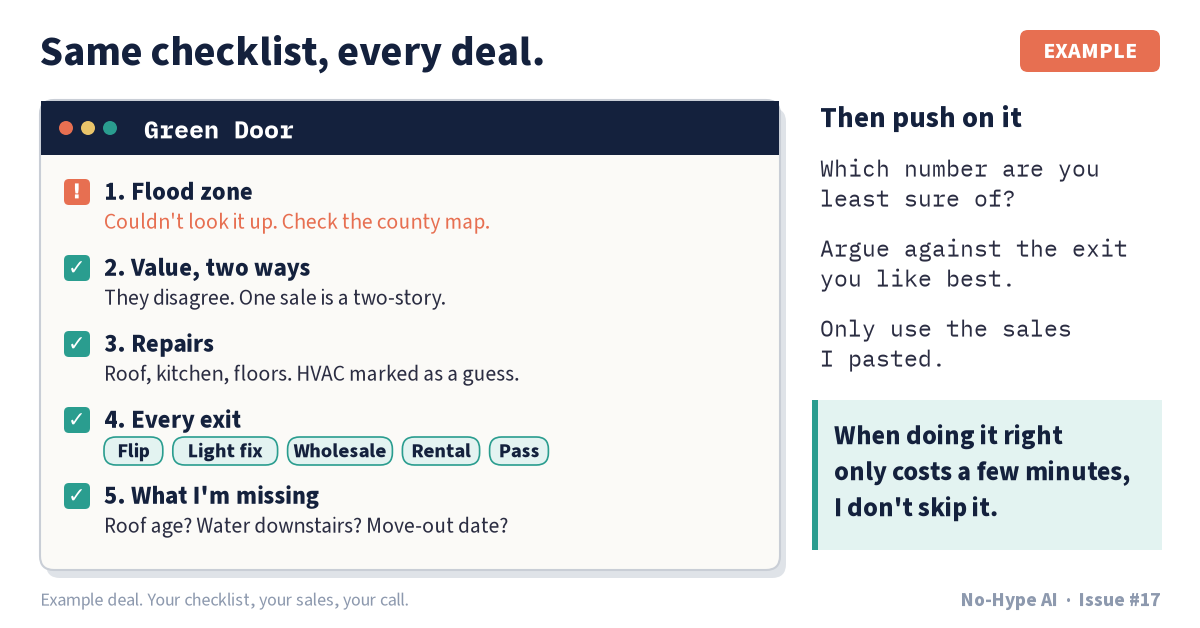
The speed is nice. I care more about the sameness. My AI checks the flood zone so I don't forget. It always works the value out more than one way, and it always lays out every exit before I decide. I think my underwriting's better for it. When doing it right only costs a few minutes, I don't skip it.
You can get most of that with the AI chat you already use. Give it the same checklist on every deal.
Write the checklist once
Put this in the same project where you keep your deal ledger from last issue, in the project instructions if yours has them:
Before you tell me anything about a deal, run my checklist, in this order, every time.
Flood zone. Look it up, or tell me plainly that you couldn't. Don't guess.
Value, worked out at least two different ways from the sales I give you. Show each one and tell me where they disagree.
Repairs. List what the house needs based on what I told you, and mark anything you're guessing at.
Every exit. Fix and sell, light fix and sell, wholesale by assigning the contract, keep it as a rental, or pass. Tell me what each one needs to work.
What I'm missing. Give me the questions I should ask the seller before I make an offer. If you don't have a piece of information, say so and leave it blank.
The order matters. Flood zone goes first because it's the one you forget, and it can change what a house is worth and who can buy it. Exits go near the end because you shouldn't pick one until you've seen the value and the repairs.
Feed it real sales
Pull the comps yourself and paste them in. A general AI chat will make up a sale that looks real if you let it, and a made-up comp reads just as clean as a real one.
Give it the sales you'd actually defend to a partner. If you wouldn't stand behind a comp in person, don't hand it to the AI either.
What it looks like on a real deal
Here's a made-up one. Say a seller calls about a split-level you're calling Green Door. You've walked it, you've got your notes, and you've pulled a handful of sales nearby. You paste the notes and the sales under the checklist and hit enter.
On flood zone, it tells you it can't look up flood maps from where it sits, and to check the county flood map before you go any further. Good. That's the honest answer, and now it's on your list instead of in the back of your head.
On value, it works it out from the closest sales, then again from price per square foot across all of them. The two land in different places, and it tells you why. One of your sales is a two-story, and it's pulling the second number up. You take it out and run it again.
On repairs, it lists the roof, the kitchen, and the flooring from your notes, and it marks the HVAC as a guess because you never said anything about it.
On exits, it walks through each one. A full flip needs the value to hold after the repairs. A light fix needs the kitchen to be livable as is. Wholesale needs enough room left for another investor. A rental needs the rent to carry it. Or you pass.
Then it gives you questions for the seller: how old the roof is, whether water's ever come in downstairs, and when they need to be out.
Now you push on it. Ask which number it's least sure of. Ask which exit it would pick and why. Then make the call yourself.
When you're done, tell it to add Green Door to your ledger.
When it goes wrong, and the fix
It gets lazy in a long thread. After a few deals it starts skipping steps or blending two houses together. Start a new thread for each deal, and if it skips anyway:
Run the full checklist again from step one. Number every step, and don't skip any.
It uses sales you didn't give it. That's the made-up comp problem. Catch it like this:
Only use the sales I pasted. If you used anything else, tell me which ones and take them out.
It says the flood zone looks fine without checking anything. Ask it straight:
How did you check the flood zone? If you didn't look it up, say so.
It falls in love with one exit and cheerleads. Make it argue the other side:
Argue against the exit you like best. What would make it the wrong call on this house?
Start this week
Paste the checklist into your project today.
Take the next deal that comes across your desk and run it through the checklist before you do anything else. Then run the one after that the same way.
Keep one note of every time it caught something you would have missed. You'll know pretty quick whether it earns its spot.
Know an operator who underwrites from memory on a busy afternoon? Forward this. And hit reply and tell me: what's on your checklist that I left off?
Written by Paul Cobb, real estate operator (Louisville / Kentuckiana), forVEX builder. I run the plays I write about. More depth: forvex.app/journal